





News Foreign

COVID-19: Rwanda takes delivery of robots that can screen ‘150 people per minute’

Robots are now part of Rwanda’s fight against COVID-19 and will help minimise the risk of infections among healthcare workers, authorities said on Tuesday.

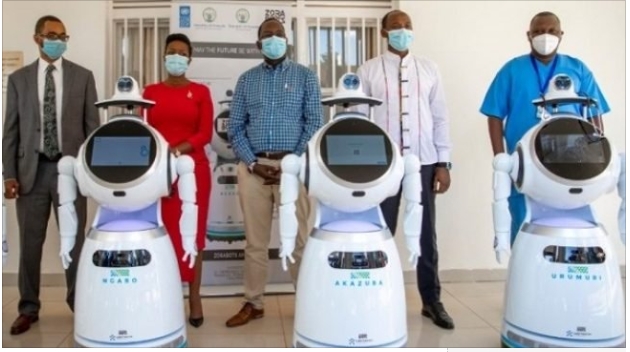
Five anti-epidemic robots – named Akazuba, Ikirezi, Mwiza, Ngabo, and Urumuri – will be mainly used to administer temperature checks, monitor patient status, and keep medical records of COVID-19 patients, the Health Ministry announced in a series of tweets.

“These high-tech robots have the capacity to screen 50 to 150 people per minute, deliver food and medication to patient rooms, capture data and notify officers on duty about detected abnormalities,” the ministry said.

Health Minister Ngamije Daniel said the robots will fasten service delivery and help protect the lives of valuable health workers.

“Medics and other frontline workers visit patients’ room many times to deliver medication, meals, carry out tests, among other things – and this may increase their risk of contracting the virus,” he was quoted as saying by local daily The New Times.

The robots are the result of joint efforts by the Rwandan Ministry of ICT and Innovation and the United Nations Development Programme (UNDP).

“The infectious nature of COVID-19 calls for technological innovations to tackle the pandemic. This is why Rwanda has introduced robots and drones among other high-tech initiatives to enhance efficiency in the fight,” ICT and Innovation Minister Paula Ingabire said.

UNDP representative Stephen Rodriques said the project marks the “beginning of a great collaboration […] that’s part of a broader partnership” with the East African country.

Rwanda, a major innovation and technology hub in Africa, has recorded 308 coronavirus cases so far, with zero deaths and 209 recoveries, according to official figures.

To date, more than 52,300 tests have been carried out in the country of over 12 million

Related posts

Ghana will receive €100 million this year from the German government under its ‘Compact with Africa’ Programme to support the country’s renewable energy sector. Germany is providing the funding through its technical cooperation agency, GIZ, and development bank, KfW. The two countries are currently finalising modalities of the financial support which will include technical and vocational training for Ghanaians in the renewable energy sector. Event The Deputy Head of Mission at the German Embassy, Mr Hans-Helge Sander, disclosed this at the opening of the 2017 West Africa Clean Energy and Environment (WACEE) Exhibition and Conference in Accra on Tuesday. “Ghana has been named as one of the three countries in Africa to benefit from the bilateral reform partnership within the G-20 ‘Compact with Africa’ Programme. The initiative will bring up to an additional €100 million to support the renewable energy sector in Ghana,” he said. Mr Sander explained that the financial support was a government-to-government arrangement, which meant that the federal government would task GIZ and KfW to implement Germany’s contribution. “I am pointing this out because lately, several private companies have approached the embassy with requests for information about how the private sector can benefit from the German offer. As I said, there will be no direct opening for cooperation between the German government and private companies,” the deputy head of mission stated. However, he added that there would be options for participation through public tenders and calls for proposal when KfW, GIZ and the Ghanaian government start implementing the funding from the compact. Asked how the fund would be implemented, Mr Sander told the Daily Graphic that the implementation would be done through the Government-goes-Solar initiative or other programmes. “Details of the implementation are still under discussion between the two governments,” he added. Measures The Director In-charge of Renewable and Alternative Energy at the Ministry of Energy, Mr Wisdom Ahiataku-Togobo, who represented the minister of energy, said the government was putting in place policies and measures to help attract private sector investment into the renewable energy sector. “Ghana has followed the footsteps of Germany and has enacted a Renewable Energy Act which seeks to create the enabling environment for attracting private sector investment in renewable energy and energy efficiency,” he said. He said the country had also realised some modest growth in the renewable energy sector as it could now boast a 22.5-megawatt (MW) capacity of utility scale solar farm. “We can also boast a waste-to-energy power plant in operation at Ashaiman which has tremendously improved the sanitation situation in the Ashaiman District,” he said, adding that the government intended to replicate that in other districts.

ghwishradioadmin

ECG announces 22-day ‘Dumsor’ schedule for parts of Accra

ICON

BREAKING : 137 Christians Have Been Bombed & Killed On Easter sunday

ghwishradioadmin

This website uses cookies to improve your experience. We'll assume you're ok with this, but you can opt-out if you wish. Accept Read More

close

Enjoying this blog? Please Subscribe to other Channels & spread the word :)